

- What Is AI Chatbot Booking?
- How AI Chatbot Booking Helps Service Businesses
- 1. Books Customers 24/7 Without Staff Involvement
- 2. Reduces No-Shows Significantly
- 3. Eliminates Phone Tag and Waiting
- 4. Frees Up Your Staff for Higher-Value Work
- 5. Captures Leads Who Are Not Ready to Book Yet
- 6. Increases Revenue Through Smart Upselling
- 7. Fills Empty Calendar Gaps
- 8. Gives You Data to Make Better Decisions
- Industry-Specific Benefits
- How AI Chatbot Booking Works on a WordPress Website
- AI Chatbot Booking vs. Traditional Online Booking Forms
- Common Concerns About AI Chatbot Booking
- “Will customers actually use a chatbot to book?”
- “What if the chatbot makes a mistake?”
- “Is it expensive to set up?”
- “Will it feel impersonal?”
- The Numbers That Matter
- How to Get Started
- Final Thoughts
Service businesses lose money every single day because of missed calls, slow booking processes, and no-shows. If you run a salon, clinic, consulting firm, gym, or any appointment-based business, you already know this problem.
Here is a number that should bother you: 27% of calls to home service businesses go unanswered, and 41% of weekend calls are missed entirely. Most of those callers will not leave a voicemail. They will call your competitor instead.
AI chatbot booking changes this completely. It puts a smart assistant on your website that takes bookings through natural conversation, 24 hours a day, 7 days a week. No forms. No phone tag. No missed opportunities.
This guide explains exactly how AI chatbot booking helps service businesses grow revenue, cut costs, and keep customers happy. Every claim is backed by real data.
What Is AI Chatbot Booking?

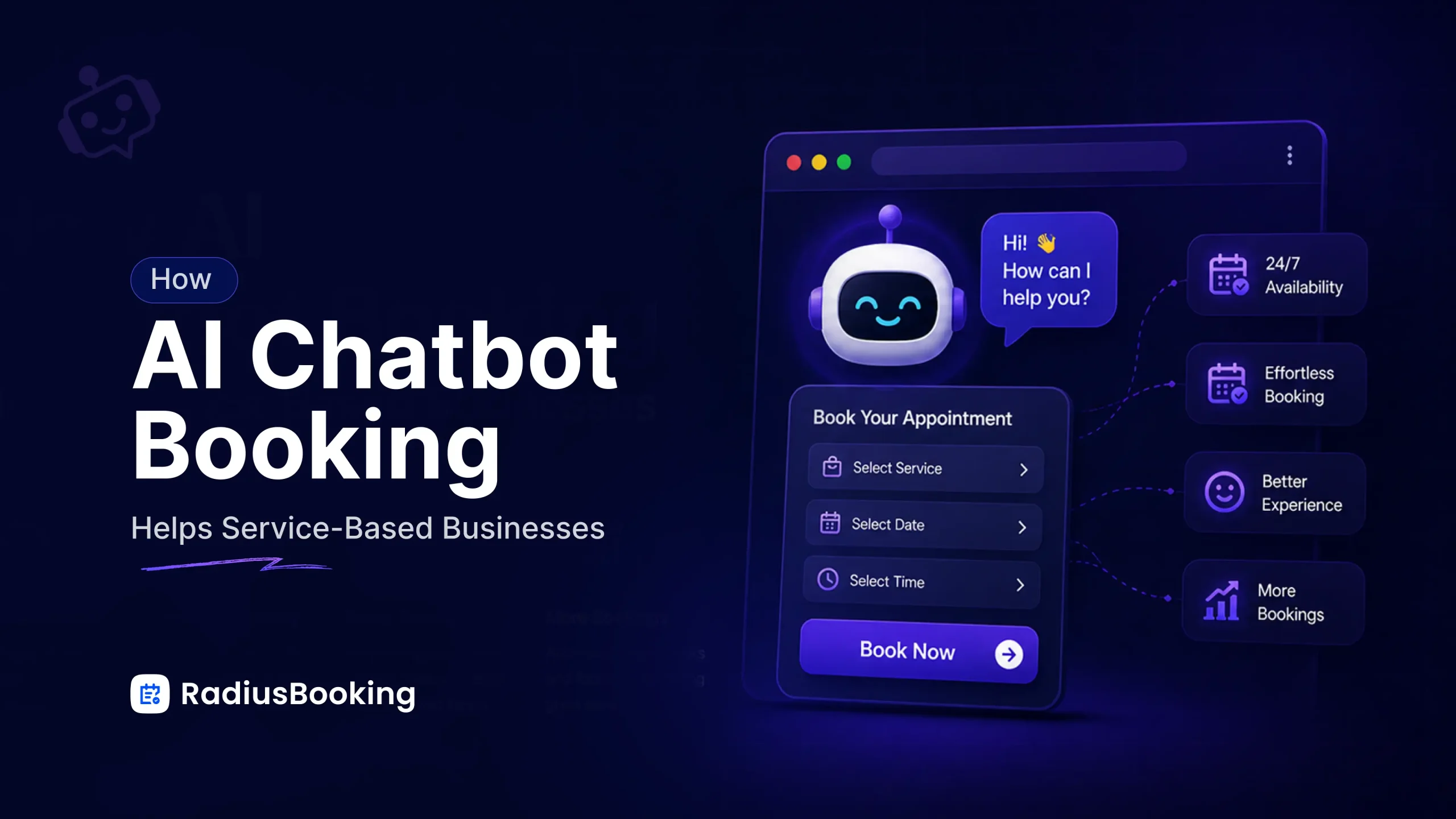
AI chatbot booking is a system that lets customers schedule appointments through a conversational chat interface on your website (or social media channels) instead of filling out traditional booking forms or calling your office.
Unlike basic booking forms that walk users through rigid steps (pick a service, pick a date, pick a time), an AI chatbot understands natural language. A customer can type something like:
“I need a 60-minute massage with Anna next Friday afternoon.”
The AI understands the service, the preferred staff member, the day, and the time preference. It checks real-time availability, offers matching slots, confirms the booking, and sends a confirmation. The whole process takes under two minutes.
This is different from a simple rule-based chatbot that only responds to button clicks or preset options. AI chatbots use natural language processing (NLP) to understand what customers actually mean, even when they phrase things differently each time.
How AI Chatbot Booking Helps Service Businesses
1. Books Customers 24/7 Without Staff Involvement
Your front desk closes at 6 PM. But your customers do not stop looking for services at 6 PM.
Research from Acuity Scheduling shows that 40% of online appointment bookings happen outside regular business hours. That is nearly half of your potential bookings happening when nobody is available to answer the phone or respond to emails.
An AI chatbot handles those after-hours bookings automatically. It greets website visitors, answers their questions about your services, and walks them through the booking process at 2 AM on a Sunday just as smoothly as it would at 10 AM on a Tuesday.
For a salon that gets 200 bookings per month, capturing that extra 40% after-hours demand could mean up to 80 additional bookings per month. At an average service value of $60, that is $4,800 in monthly revenue that would otherwise be lost.
2. Reduces No-Shows Significantly
No-shows are one of the most expensive problems for service businesses. The average no-show rate across service industries ranges from 10% to 30%. For a business with 40 appointments per week, even a 15% no-show rate means six empty slots every single week.
AI chatbot booking attacks this problem in several ways.
Instant booking builds stronger commitment. Research published in the Journal of Dental Education shows that patients who book during their initial contact have a 14% higher show rate than those who book through callbacks. When an AI chatbot books the appointment in the moment of intent, the commitment is stronger.
Automated reminders through the right channel. AI systems send timed reminder sequences: a confirmation at booking, a reminder 24 hours before, and a final reminder 2 hours before. A peer-reviewed study across 135,000+ appointments found that AI-driven reminders cut no-show rates by 50.7%, dropping them from 20.82% to 10.25%.
Easy rescheduling instead of no-showing. When customers can simply tell the chatbot “I need to move my Thursday appointment,” they reschedule instead of disappearing. This converts potential no-shows into rebooked appointments rather than lost revenue.
Businesses using automated reminders through chatbots typically see no-show rates drop to the 5-10% range. For a practice losing $150,000 per year to no-shows (which is average for dental practices according to ADA data), cutting that by half recovers $75,000 annually.
3. Eliminates Phone Tag and Waiting
73% of customers prefer not to call for appointments. Yet many service businesses still rely on phone-only booking systems. This creates a gap between what customers want and what businesses offer.
Phone booking has several problems that AI chatbots solve:
Hold times frustrate customers. When a potential customer calls and gets put on hold, every passing second increases the chance they will hang up and try someone else. A chatbot responds instantly, every time.
Phone calls take 4-8 minutes per booking. A chatbot completes the same booking in under 2 minutes because there is no small talk, no hold time, and no back-and-forth searching for available slots.
One receptionist handles one call at a time. An AI chatbot handles multiple conversations simultaneously. During peak hours when your phones are ringing off the hook, the chatbot ensures no customer is left waiting.
Language barriers disappear. Modern AI chatbots support multiple languages automatically, which makes booking easier for customers in diverse communities.
4. Frees Up Your Staff for Higher-Value Work
When your front desk spends hours answering the same booking questions and scheduling appointments manually, they cannot focus on the customers standing right in front of them.
Research from Juniper Research shows that chatbot-assisted booking reduces scheduling staff workload by 60%. That does not mean you fire your receptionist. It means your receptionist can focus on greeting walk-in clients, handling complex requests, providing better in-person service, and upselling additional treatments or packages.
A dental practice case study found that deploying an AI chatbot reduced front-desk workload by 30-50%, allowing staff to focus entirely on patient care and in-office experience. The clinic handled the same volume of bookings with fewer scheduling errors and happier staff.
For small businesses running lean teams (or solo operators with no front desk at all), an AI chatbot acts as a virtual receptionist at a fraction of the cost of hiring. One comparison found that an AI booking chatbot costs roughly $79/month compared to $3,200/month for an additional receptionist.
5. Captures Leads Who Are Not Ready to Book Yet
Not every website visitor is ready to book right now. Some are comparing services. Others are checking your prices. A few just want to ask a quick question before committing.
A traditional booking form only captures people who are ready to book this second. Everyone else leaves your site without a trace.
An AI chatbot engages those “not yet ready” visitors in conversation. It answers their questions, provides information about your services, and collects their contact details naturally. Even if they do not book today, you now have their name, email, and phone number in your system for follow-up.
This turns your website into a lead generation machine that works around the clock. You can follow up with those leads through email, text, or retargeting ads to bring them back when they are ready.
6. Increases Revenue Through Smart Upselling
A well-configured AI chatbot does not just take bookings. It actively increases your average ticket value.
When a customer books a basic haircut, the chatbot can suggest adding a conditioning treatment. When someone books a 30-minute consultation, it can mention the benefits of the 60-minute session. When a patient schedules a routine checkup, it can remind them about overdue treatments.
This happens naturally within the conversation, not as a pushy pop-up. The AI learns which upsells are most relevant based on the service being booked and presents them at the right moment.
For service businesses, even a modest 10-15% increase in average ticket value adds up significantly over the course of a year.
7. Fills Empty Calendar Gaps
Empty slots during off-peak hours cost you money. An AI chatbot can actively promote these open times.
When a customer asks for a popular time slot that is full, the chatbot can suggest nearby available times: “Sarah is booked at 2 PM on Tuesday, but she has openings at 11 AM and 4 PM. Would either of those work?”
Some AI booking systems go further by offering discounted rates during slow periods, automatically promoting last-minute openings, and sending messages to customers on the waitlist when cancellations create new availability.
This keeps your calendar fuller and your revenue more consistent throughout the week.
8. Gives You Data to Make Better Decisions
Every conversation your AI chatbot has generates data. Over time, this data reveals patterns that help you run your business smarter.
Common questions tell you what is missing from your website. If 30% of chatbot conversations involve pricing questions, your pricing page probably needs work.
Booking patterns show peak demand. You can see which days, times, and services get the most bookings and adjust staffing or marketing accordingly.
Drop-off points reveal friction. If customers start the booking process but abandon it at a specific step, you know exactly where to improve.
Staff performance becomes measurable. You can track which team members get the most bookings, the highest rebooking rates, and the best customer satisfaction scores.
This kind of data used to require expensive business intelligence tools. Now your chatbot collects it automatically as part of doing its job.
Industry-Specific Benefits
AI chatbot booking works for any appointment-based business, but certain industries see especially strong results.
Salons and Spas
Salon clients often want to book with a specific stylist at a specific time. An AI chatbot handles this naturally: “I’d like a balayage with Jessica on Saturday morning.” The chatbot checks Jessica’s Saturday schedule and offers available slots instantly.
Salons also benefit from the upsell capability. When a client books a haircut, the chatbot can suggest adding a deep conditioning treatment or a blowout. A multi-location dental group (similar service model) saw cosmetic procedure bookings increase by 20% within six months of adding AI chatbot booking.
Healthcare and Dental Practices
Healthcare providers face some of the highest no-show rates in any industry. AI scheduling systems in healthcare achieve over 90% accuracy in predicting which appointments are at risk, allowing practices to send extra reminders or activate waitlist backups.
One hospital network saw appointment bookings rise by 47% after deploying AI chatbots for scheduling. The chatbot handled initial patient inquiries, matched patients with the right specialist, and collected necessary intake information before the visit.
For dental practices, the numbers are particularly compelling. The average dental practice loses $150,000 per year to no-shows. AI chatbot booking with automated reminders cuts that loss dramatically.
Fitness and Gyms
Fitness businesses juggle group classes, personal training sessions, and trial visit bookings. An AI chatbot can handle all three types of bookings in a single conversation.
A potential member might ask: “Do you have a beginner yoga class on Wednesday evenings?” The chatbot checks the schedule, shows available classes, and books the spot. If the class is full, it offers alternatives or adds the customer to a waitlist.
For personal training, the chatbot can match potential clients with trainers based on their goals, schedule, and experience level.
Consultants and Coaches
For consultants and coaches, time is the product. Every minute spent scheduling is a minute not spent with paying clients.
AI chatbot booking is particularly valuable here because it can qualify leads before booking. The chatbot can ask screening questions like budget range, project scope, or specific needs. This ensures that only qualified prospects end up on your calendar, saving you from discovery calls that go nowhere.
The Fluent ecosystem (FluentBooking + FluentCRM) is especially useful for consultants who want to automate the journey from chatbot conversation to email nurture sequence to booked consultation.
Home Services
Home service businesses (plumbers, electricians, HVAC, cleaning) miss more calls than almost any other industry. One study found that the average small contracting business loses $45,000 to $120,000 per year to unanswered phone calls alone.
An AI chatbot on your website catches those leads 24/7. It collects job details, location information, preferred scheduling, and customer contact info even when you are on another job and cannot answer the phone.
One electrical company boosted its booking rate from 10% to over 70% by replacing after-hours call handling with AI, unlocking $170,000 in new revenue.
👉 Good Read: 500+ Handyman Business Names
How AI Chatbot Booking Works on a WordPress Website
If your business runs on WordPress, adding AI chatbot booking is straightforward. Here is how the process typically works.
Step 1: Install a booking plugin with AI chatbot support. Plugins like Radius Booking offer a built-in AI chatbot that handles conversational booking natively within WordPress. This is the first WordPress booking plugin with native AI chatbot functionality.
Step 2: Configure your services, staff, and schedule. Set up each service with its name, duration, and price. Add staff members with their individual working hours and days off. The AI chatbot pulls from this data to answer customer questions and check availability in real time.
Step 3: Customize the chatbot. Adjust the chatbot’s greeting, conversation flow, and appearance to match your brand. Set up the responses for common questions about your services, pricing, and policies.
Step 4: Embed the chatbot on your website. Place the booking chatbot on your homepage, services page, or as a floating widget that appears on every page. Most WordPress booking plugins provide shortcodes, Gutenberg blocks, or Elementor widgets for easy placement.
Step 5: Connect payment processing. Link your Stripe or PayPal account so customers can pay at the time of booking. Collecting payment upfront is one of the most effective ways to reduce no-shows.
Step 6: Set up reminders. Configure automated email, SMS, or WhatsApp reminders at intervals that work for your business (24 hours before and 2 hours before are the most common).
Step 7: Monitor and optimize. Review your chatbot analytics regularly. Look at booking completion rates, common questions, and drop-off points. Adjust your setup based on what the data shows.
AI Chatbot Booking vs. Traditional Online Booking Forms
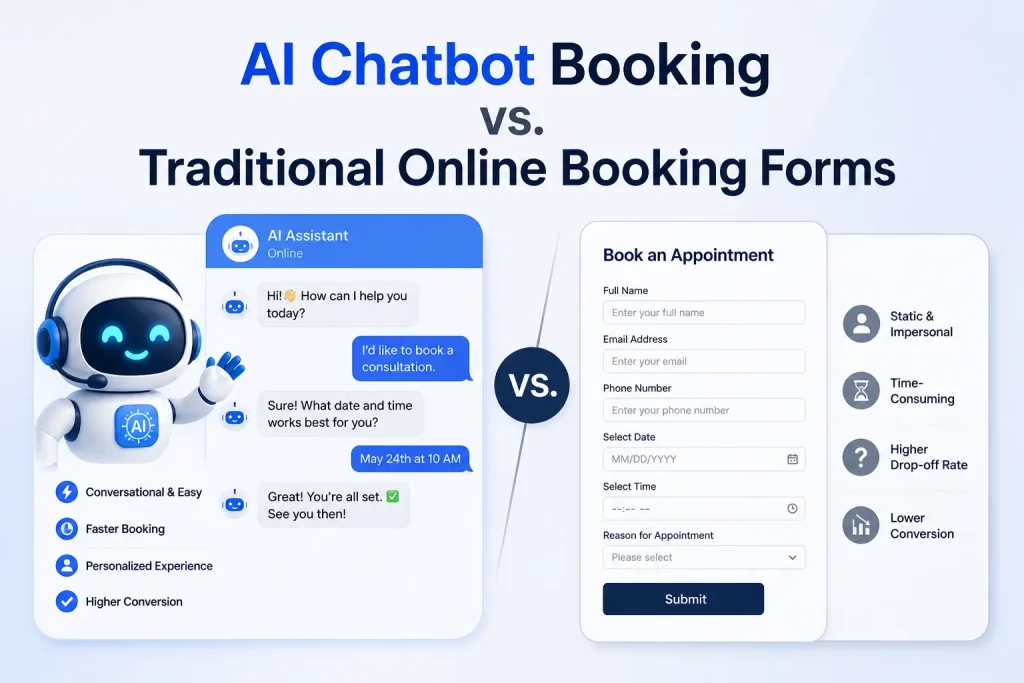
Both systems let customers book online. But the experience and results are very different.
Speed of booking. A traditional form requires customers to click through multiple steps: select a category, select a service, choose a staff member, pick a date, pick a time, fill in contact details, and confirm. An AI chatbot can handle all of this in a single natural sentence.
Handling confusion. When a customer is not sure which service they need, a form cannot help them. A chatbot can ask clarifying questions: “Are you looking for a deep tissue massage or a relaxation massage?” This guidance reduces abandoned bookings.
After-hours engagement. A booking form sits there silently. A chatbot actively greets visitors, answers questions, and nudges them toward booking. This proactive engagement converts more browsers into booked customers.
Multilingual support. Most booking forms only work in one language. AI chatbots can communicate in multiple languages automatically, making your business accessible to a wider audience.
Data collection. A form only captures data from people who complete the booking. A chatbot captures partial data from people who start a conversation but do not finish booking, giving you leads to follow up with.
Common Concerns About AI Chatbot Booking
“Will customers actually use a chatbot to book?”
Yes. 64% of consumers prefer booking appointments online rather than calling. Among younger demographics, the preference is even stronger. The conversational nature of a chatbot makes it feel more natural and less like filling out paperwork.
“What if the chatbot makes a mistake?”
Modern AI booking chatbots pull availability data directly from your calendar in real time. They cannot double-book because they only offer slots that are genuinely open. If a customer’s request is too complex for the chatbot, it can hand off to a human staff member seamlessly.
“Is it expensive to set up?”
No. WordPress-based AI booking solutions like Radius Booking start at $74 for a lifetime license. Even monthly SaaS chatbot solutions typically cost $50-100/month, which is a fraction of the cost of a part-time receptionist.
“Will it feel impersonal?”
The opposite is usually true. A chatbot that remembers a returning customer, greets them by name, and knows their preferred stylist or therapist feels more personal than being put on hold and transferred to whoever picks up the phone.
The Numbers That Matter
Here is a summary of the key statistics that show why AI chatbot booking makes financial sense for service businesses:
40% of online bookings happen outside business hours. An AI chatbot captures these around the clock.
50.7% reduction in no-show rates documented in a peer-reviewed study of 135,000+ appointments using AI reminders.
60% reduction in scheduling staff workload with chatbot-assisted booking.
26% increase in appointment volume for businesses that offer online booking compared to phone-only.
35% reduction in no-shows attributed to AI-powered automated reminders.
Under 2 minutes average time to complete a booking through an AI chatbot, compared to 4-8 minutes by phone.
$45,000-$120,000 lost annually by the average small contracting business due to unanswered calls.
How to Get Started
If you are ready to add AI chatbot booking to your service business, here is the simplest path forward:
- Audit your current booking process. Count how many bookings you handle per week, what percentage come by phone vs. online, and your current no-show rate. This gives you a baseline to measure improvement.
- Choose a booking solution with AI capabilities. For WordPress websites, Radius Booking offers built-in AI chatbot booking. For non-WordPress sites, look at standalone AI booking platforms that offer website embed options.
- Start with your most popular services. Do not try to set up everything at once. Configure your top 3-5 services and one or two staff members first. Expand once you see it working.
- Promote the new booking option. Add the chatbot to your homepage, link to it from your Google Business Profile, mention it in your email signature, and post about it on social media. The more people see it, the more bookings you will get.
- Track results for 30 days. Compare your booking volume, no-show rate, and after-hours bookings against your baseline. Most businesses see measurable improvement within the first month.
Final Thoughts
AI chatbot booking is not futuristic technology. It is available right now, it is affordable, and it delivers measurable results for service-based businesses.
The businesses that adopt it gain a real advantage: more bookings, fewer no-shows, lower costs, happier customers, and a staff that can focus on delivering great service instead of answering phones.
Your competitors are starting to add AI booking to their websites. The longer you wait, the more customers you lose to businesses that make booking easier.
Start small. Test it with your top services. Let the numbers speak for themselves.


