
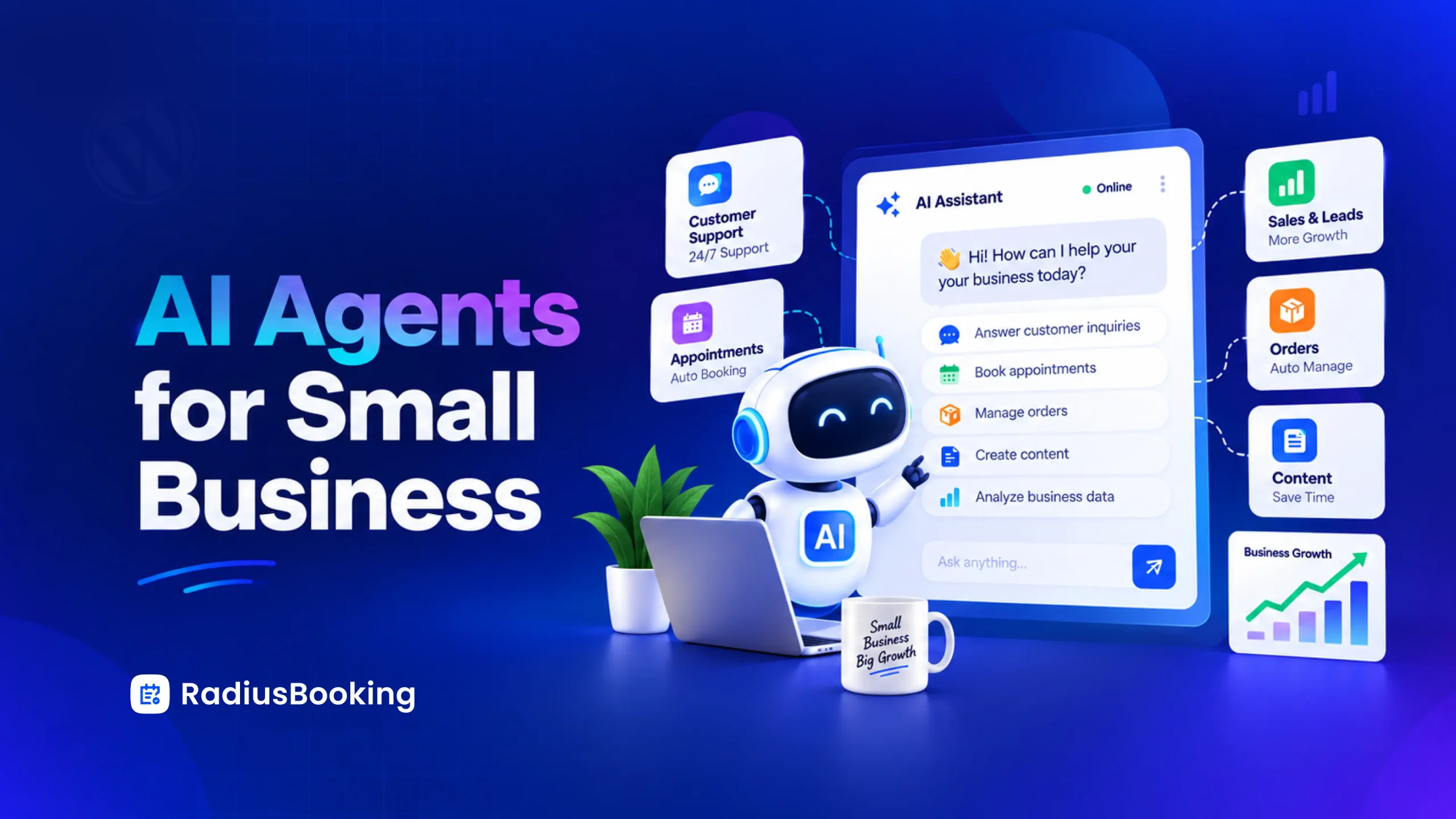

- What an AI agent actually is (and isn’t)
- Where AI agents help small businesses
- 1. Booking and rescheduling appointments
- 2. Reminders, follow-ups, and no-show recovery
- 3. First-line customer questions
- 4. Invoice chasing and payment nudges
- 5. Data entry and cross-system busywork
- Where AI agents fail small businesses
- 1. Anything that needs judgment about people
- 2. Sales conversations that require reading the room
- 3. Tasks with expensive mistakes
- 4. Businesses without clean data
- 5. Representing you in situations that need accountability
- A simple test: is this task agent-ready?
- How to start without betting the business
- Why booking is the place most small businesses should begin
- Frequently asked questions
- What is an AI agent for small business?
- What is the difference between an AI agent and a chatbot?
- Are AI agents worth it for a small business?
- What tasks should a small business never give to an AI agent?
- How much does an AI agent cost for a small business?
- Do AI agents replace employees in a small business?
- How do I know if my business is ready for an AI agent?
- What is the best first AI agent for a service business?
- The honest summary
AI agents for small business are software programs that take a goal, break it into steps, use tools like your calendar or inbox, and complete the task with little or no human input. They work well for narrow, repetitive, rule-based jobs such as booking appointments, answering routine questions, and chasing unpaid invoices. They fail when the task needs judgment, context the agent can’t see, or accountability a customer expects from a human.
That is the whole article in one paragraph. The rest explains why, with enough specifics that you can decide whether an agent belongs in your business this year or not.
We build booking software, so we have a stake in this conversation. We also talk to hundreds of salon owners, clinic managers, consultants, and trades businesses every month, and most of what they’ve been told about AI agents is either hype from vendors or fear from headlines. Neither helps you run a business. This guide tries to.
What an AI agent actually is (and isn’t)
The word “agent” is doing a lot of marketing work right now, so it’s worth pinning down.
A chatbot answers questions. You ask, it replies, the conversation ends. It doesn’t do anything outside the chat window.
An AI agent is given an outcome and the tools to reach it. “Get this customer booked for a consultation next week” is an outcome. To achieve it, the agent reads your availability, asks the customer for a preferred time, checks for conflicts, creates the booking, sends the confirmation, and logs the result. Each of those is a step it chooses and executes on its own.
The practical difference: a chatbot can tell a customer your opening hours. An agent can put them on your calendar. We covered the booking-specific version of this in What Is an AI Booking Assistant?, and the general pattern is the same across every use case below.
Three things every real agent needs:
- A clear goal it can recognise as finished.
- Tools it’s allowed to use: a calendar, a payment system, a CRM, an email account.
- Boundaries on what it may do without asking you first.
If a product doesn’t give you all three, it’s a chatbot with a new label.
Where AI agents help small businesses
The pattern across every success story is the same: the task is frequent, the rules are known, the cost of a small mistake is low, and the agent can be corrected quickly. Here are the five jobs that fit that pattern.
1. Booking and rescheduling appointments
This is the clearest win for any service business. The agent holds your availability, talks to the customer in plain language, handles “does Thursday afternoon work?” back-and-forth, and confirms the slot. It runs at 11pm when your front desk is closed, which is exactly when a large share of customers are actually free to book.
The failure mode is mild: an occasional booking in the wrong service category, which you spot and fix in seconds. The upside is a calendar that fills itself. We wrote about the mechanics in How AI Chatbot Booking Helps Service Businesses.
2. Reminders, follow-ups, and no-show recovery
Reminder sequences are the second best use of an agent because they’re pure rules and timing. Send a confirmation, remind 24 hours out, remind again two hours out, and if the slot is missed, send a reschedule link the same day. A human forgets. An agent doesn’t. Combined with a deposit policy, this is the single biggest lever most small businesses have on no-shows, and we broke the full approach down in How to Reduce Appointment No-Shows.
3. First-line customer questions
“Do you do gel nails?” “Is parking free?” “Can I bring my dog?” An agent trained on your own FAQ, policies, and service list answers these instantly and correctly, and hands off to a human the moment the question falls outside what it knows. The key phrase is trained on your own content. A generic model guessing at your policies is a liability. A model reading your policies is a receptionist that never takes a break.
4. Invoice chasing and payment nudges
Overdue invoice reminders are awkward for owners and trivial for agents. The agent knows the due date, the amount, and the customer’s preferred channel, and sends a polite nudge on a schedule you define, escalating tone slightly at each step. Because the rules are explicit and the messages are templated, there’s very little room for the agent to go wrong.
5. Data entry and cross-system busywork
Copying a new booking into a spreadsheet, tagging a customer in your CRM after their third visit, adding a lead from a web form to your email list. None of this is glamorous, and all of it is where owner hours quietly disappear. Agents connected to your existing tools do this in the background without complaint.
Where AI agents fail small businesses
The failures are just as consistent as the wins. They cluster around one theme: the agent is asked to do something that needs context or judgment it doesn’t have.
1. Anything that needs judgment about people
A regular client who’s missed twice because of a family illness should not get the same automated deposit demand as a serial no-show. An agent can’t tell the difference unless someone told it, and nobody ever tells it everything. The same applies to complaint handling, discount decisions, and anything where “it depends” is the honest answer. Keep humans in that loop.
2. Sales conversations that require reading the room
Agents are good at “what time works for you?” and bad at “I’m not sure this is worth the money.” Objection handling, upselling with taste, and knowing when to stop pushing are skills that depend on tone, hesitation, and history. An agent that pushes too hard costs you the customer, and you’ll never see the transcript.
3. Tasks with expensive mistakes
Refunds, cancellations of large bookings, anything touching money at scale. The agent will get it right 95% of the time, and the 5% will be the ones you hear about. If a single error costs more than a week of the agent’s savings, that task needs a human approval step, not full autonomy.
4. Businesses without clean data
An agent is only as good as the calendar, price list, and policies it can read. If your availability lives in three places, your prices changed but the website didn’t, and your cancellation policy is “it depends who’s asking,” the agent will confidently give customers wrong information. Fix the data first. This is the most common reason AI pilots quietly get switched off.
5. Representing you in situations that need accountability
When something goes wrong, customers want a person who can own it. An agent saying “I understand your frustration” makes things worse, not better. Any interaction where a customer might reasonably ask “who’s responsible for this?” should route to a human before it escalates, not after.
A simple test: is this task agent-ready?
Run any task you’re thinking of handing to an agent through these five questions. Four or five yeses means go ahead. Two or fewer means keep it human for now.
| Question | Agent-ready answer |
|---|---|
| Does it happen at least several times a week? | Yes |
| Could you write the rules on one page? | Yes |
| Is a mistake cheap and easy to reverse? | Yes |
| Does the agent have clean access to the data it needs? | Yes |
| Would a customer be fine knowing a bot did it? | Yes |
Booking an appointment passes all five. Handling a refund dispute fails at least three. That’s the line.
How to start without betting the business
The businesses that get real value from agents don’t start with “let’s automate everything.” They start with one boring, high-volume task, run it alongside the human process for a few weeks, and only then expand.
- Pick one task from the “helps” list above. Booking is usually the best first choice because the payoff is immediate and visible.
- Write the rules down before you configure anything. If you can’t write them, the agent can’t follow them.
- Set boundaries. Decide what the agent may do alone and what needs your sign-off. Start conservative.
- Watch the logs for the first month. Read what the agent actually said to customers.
- Measure one number. Bookings per week, hours saved, no-show rate. If it doesn’t move, stop.
Why booking is the place most small businesses should begin
We’re biased, and we’ll say so. But the reasoning holds regardless of which tool you use. Booking is high-frequency, rule-bound, low-risk per mistake, and customers already expect to do it without a human. It’s the one job where the agent’s strengths line up almost perfectly with the task, and where the failure modes are the mild kind you fix in seconds rather than the kind that costs you a client.
An AI booking agent that handles the conversation, checks your real availability, takes the deposit, and sends the reminders is the difference between a form customers abandon and a conversation they finish. We compared the two directly in Conversational Booking vs Booking Forms, and the revenue side of a fuller calendar is covered in How Online Booking Increases Revenue.
Frequently asked questions
What is an AI agent for small business?
An AI agent for small business is software that takes a goal, such as booking a customer or chasing an invoice, and completes it by using tools like your calendar, email, or payment system on its own. Unlike a chatbot, which only answers questions, an agent takes actions across multiple steps and reports back when the task is done.
What is the difference between an AI agent and a chatbot?
A chatbot responds to messages but cannot act outside the conversation. An AI agent is given an outcome and the tools to reach it, so it can check availability, create a booking, send a confirmation, and update your records without being told each step. The simplest test: a chatbot can tell a customer your hours, while an agent can put them on your calendar.
Are AI agents worth it for a small business?
They are worth it for narrow, repetitive, rule-based tasks like appointment booking, reminders, FAQ answers, and invoice follow-ups, where they save hours every week and rarely make costly mistakes. They are not worth it for tasks needing judgment, sales finesse, or accountability, or for businesses whose data and policies are not yet organised enough for an agent to read reliably.
What tasks should a small business never give to an AI agent?
Keep humans on refunds, complaint resolution, discount decisions, high-value sales conversations, and any interaction where a customer might ask who is responsible. These tasks depend on context the agent cannot see and carry costs that outweigh the savings when the agent gets them wrong. Use an agent to route these to a person quickly rather than to handle them.
How much does an AI agent cost for a small business?
Costs vary widely, from AI features bundled into booking or CRM software you already pay for, to standalone agent platforms priced per seat or per conversation. The more useful question is cost per task compared to the hours it replaces. For a booking agent, one recovered no-show or one after-hours booking per week typically covers the subscription.
Do AI agents replace employees in a small business?
In practice they replace tasks, not people. The jobs agents do well, such as scheduling, reminders, and data entry, are the parts of a receptionist’s or owner’s day that nobody enjoys. The judgment-heavy work stays human. Most small businesses that adopt agents end up with the same headcount doing higher-value work rather than fewer staff.
How do I know if my business is ready for an AI agent?
Your business is ready when the task you want to automate happens often, the rules fit on one page, mistakes are cheap to reverse, the agent can access accurate data, and customers would be comfortable knowing a bot handled it. If your prices, availability, or policies live in several inconsistent places, organise those first or the agent will confidently give customers wrong answers.
What is the best first AI agent for a service business?
Appointment booking is the best first agent for most service businesses. It runs constantly, follows clear rules, has low-cost failure modes, and customers already expect to book without talking to a human. Pairing it with automated reminders and no-show follow-ups gives you a visible result, a fuller calendar, within the first few weeks.
The honest summary
AI agents are neither the end of small business nor the end of hard work. They’re a good employee for a narrow set of jobs and a bad one for everything else. The businesses winning with them right now aren’t the most technical. They’re the ones who picked the right task, wrote the rules down, and kept a human on the decisions that matter.
If booking is the task you want to hand off first, see what an AI booking agent looks like on a real calendar. Check Radius Booking demo.


